
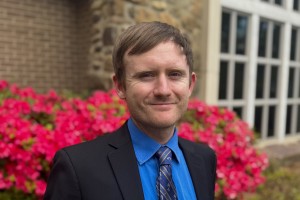
For Kieran J. O’Keefe ’14, the journey from studying history at 91´«Ã½ Saint Mary College to serving as an Assistant Professor of History at Lyon College has been driven by a lifelong passion for local history. That dedication is culminating in the launch of his new book, Suffering for the Crown: The Hudson Valley Loyalists and the Violence of Revolution, which will be published on June 12 by the University of Virginia Press.
In celebration of the upcoming release, O’Keefe will be returning to the Hudson Valley to give two public talks. Local history enthusiasts can catch him at the Walden Public Library on Thursday, June 4 at 6 p.m. or at the Fort Montgomery State Historic Site on Saturday, June 13 at 1 p.m.
We caught up with Kieran to discuss what motivated his deep dive into Revolutionary War history, how his professors at the 91´«Ã½ laid the groundwork for his development as a researcher, and his favorite memories of life as a Knight.
What motivated you to write your new book?
Growing up in the Hudson Valley, I always had an interest in local history, especially Revolutionary War history. The Hudson Valley was at the center of much of the war. From 11th grade until I started my Ph.D. program, I worked at the New Windsor Cantonment, where I dressed up as a Continental Army soldier from Massachusetts. When I started graduate school, I knew I wanted to do something with the Revolutionary War, and ultimately decided to explore how the conflict shaped local communities. As such, I wrote my M.A. thesis on the Loyalists (colonists who remained loyal to Great Britain) in Newburgh. For my Ph.D., I decided to look at the Hudson Valley Loyalists and violence specifically. The Hudson Valley was one of the most contested regions of the war, situated between British Canada to the north, British-occupied New York City to the south, and Indigenous peoples allied with the British to the west. As such, it was the scene of significant violence from conventional armies and low-level conflict between Patriots and Loyalists. Following the war, many Loyalists were expelled or fled the region, with thousands settling in what became Canada. After completing my doctorate, I turned my dissertation into a book.
How did the 91´«Ã½ prepare you for your position as a history professor?
I teach at a small liberal arts college, Lyon College, which has some similarities to the 91´«Ã½. Lyon is small, like the 91´«Ã½. [Lyon] is affiliated with the Presbyterian Church. Just having attended a small liberal arts college has made me much better prepared to work in that environment than if I had gone to a different school as an undergraduate. The small class sizes, close relationships with students, and emphasis on a broad-based education are all very familiar to me in a way they would not be had I attended a larger state university.
Are there any specific professors who helped you to become the success you are today?
I worked closely with Drs. Stan Pycior, Jeff Kahana, and John Reilly, while I was a student. All three of them gave me some tips about graduate school and looked over my writing sample when I applied. Interestingly, Dr. Reilly’s dissertation was about the confiscation of Loyalist estates in New York, which overlapped with my dissertation topic. So, I ended up reading his dissertation as a graduate student. Dr. Kahana also hired me as a research assistant for a couple of summers, where I went through collections at the Franklin D. Roosevelt Presidential Library in Hyde Park. That was my first time visiting a real archive, and it gave me the hands-on experience of being a historian. When I started graduate school and began doing archival work for my own research, I knew what to expect. Given how much time I have spent in archives in the years since, my early experience working for Dr. Kahana laid much of the groundwork for my later development as a researcher.
What are your favorite 91´«Ã½ memories?
I remember having a lot of good times off campus with my friends, going to places like the Alexis Diner and the Poughkeepsie Galleria. On campus, I had fun playing video games in the Knight Room with friends, going to the spring block party, playing flag football on Kaplan Field, and just watching playoff football, baseball, and hockey in our dorm rooms.
What would you tell a high school student considering classes at the 91´«Ã½?
There are a lot of benefits to going to a smaller college. It’s much easier to build close relationships with your professors, there are more campus leadership opportunities, and there is a distinct sense of community. For example, I was the president of the 91´«Ã½’s Phi Alpha Theta chapter (the history honor society), an opportunity I may not have had at a larger institution. All of those characteristics will benefit students when they transition to their professional careers. In a different vein, I'd also add that you would struggle to find a campus with a better view than the 91´«Ã½.